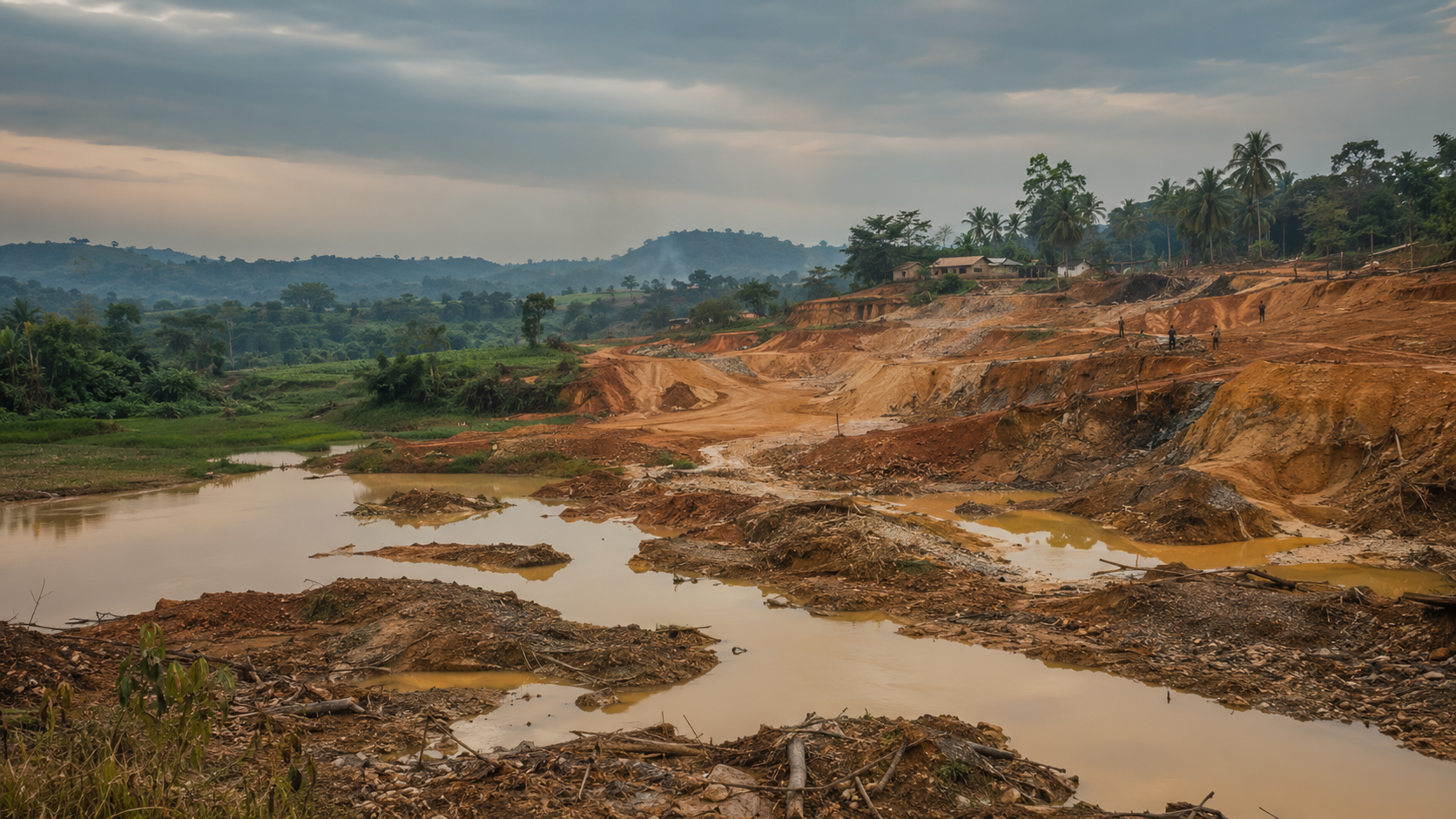
Illegal mining, popularly known as galamsey, has become one of Ghana’s most urgent environmental, social and governance challenges. This paper examines how artisanal and small-scale mining has evolved from traditional livelihood-based activity into increasingly mechanised and often illegal and irresponsible mining operations, with serious consequences for water bodies, forests, farmlands, public health and community livelihoods.
The paper traces the historical roots of mining in Ghana, reviews the legal and regulatory framework governing small-scale mining in Ghana and highlights the institutional weaknesses, political economy issues and enforcement failures that continue to undermine efforts to address the crisis. It also discusses the human impact of irresponsible mining, including livelihood disruption, health risks, child labour, social fragmentation and the growing vulnerability of mining-affected communities.
The paper recommends stronger institutional coordination, community engagement, transparency in mining licences and ownership, protection for journalists and environmental defenders, national consensus-building beyond partisan politics and a temporary moratorium on new mining licences to allow for a proper review of existing operations.
This article is based on a paper authored by Kwaku Afari, Technical Director of Wacam, commissioned and first published by the Media Foundation for West Africa. It is shared here with acknowledgement of MFWA’s role in initiating and publishing the original work.
Read the full paper here: https://mfwa.org/wp-content/uploads/2025/11/The-Environmental-and-Socio-Economic-Impact-of-Illegal-Mining-on-Local-Communities-in-Ghana-edited.pdf